Grace Lawson, Boston Garden stampede survivor
Just One LookGrace Lawson’s life begins to unravel at Photomat, where a strange photograph makes her question what she knows about her husband and starts the search that turns his disappearance into a danger she must investigate. Her response is shaped by earlier losses and by the lasting physical and cognitive effects of surviving the Boston Garden stampede: the photograph does not merely offer a clue, but confronts her with a past she cannot fully remember.
Identity and Earlier Loss
Grace’s sense of time is marked by bereavement. Her father raised her after her parents’ deaths, but his heart, weakened by rheumatic fever in childhood, failed during her freshman year of college. An uncle in Los Angeles offered to take her in; because she was already of age, she chose instead to remain in the East and make her own way. The passage gives her independence a concrete origin: it follows another sudden loss, rather than a clean break from family history.
Her parents’ deaths also sharpened her awareness of how quickly ordinary life can disappear. She wanted to gather memories and give her children, Emma and Max, plenty to remember her by. While thinking of her parents and noticing how much older the children looked than in the previous year’s apple-picking photographs, she came across the bizarre image. That moment links the family photographs she values as records of change with an image that unsettles her understanding of the past.
The Photograph and Jack’s Disappearance
The photograph is physically incongruous among the developed pictures: it is the same size as the others, but its backing seems flimsier and cheaper, more like a photocopy. Grace studies a group of young people and recognizes one figure as a possibility. A blonde woman’s face has been crossed out; beside her stands a young man whose turned head and adolescent-thin beard make identification difficult. Grace asks herself whether he could be Jack, but the picture offers only a profile, not certainty.
The uncertainty has a personal history. Grace had not known Jack when he was that young. They met thirteen years earlier on the Côte d’Azur, where she was taking a break from studying art at the University of Paris. By then she had spent more than a year undergoing surgery and physical therapy after the stampede. She still had headaches, memory loss, and a limp, and the publicity surrounding the tragedy had made her want to get away. The possible recognition in the photograph therefore reaches across a period she did not share with Jack and a period of her own life still affected by injury.
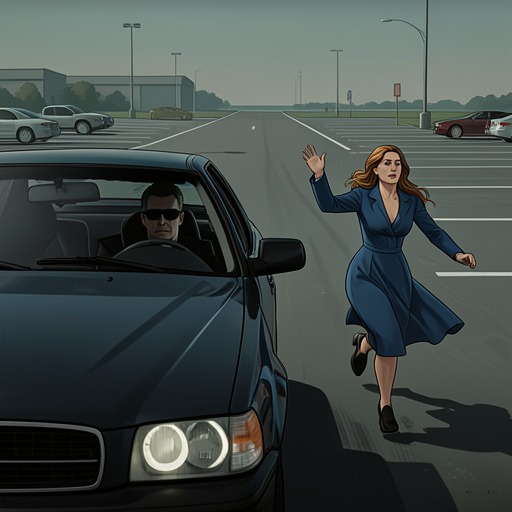
The photograph soon becomes more than an unsettling object. After Jack sees it, he runs out, and Grace initially has to reckon with the possibility that his disappearance means he wants to leave. A phone call changes that understanding. She learns that Jack is in trouble: he has not disappeared because he is fleeing her or afraid of commitment, and his absence was neither expected nor planned. The image has not explained what happened, but it has connected the photograph to an immediate threat.
Injury, Memory, and Survival
Grace’s memory difficulties have a physical cause established after the stampede. In a dream she experiences the terror of being trapped and wakes gasping for air; in reality, she had awakened four days after the event with almost no memory of what had happened. At first she thought it was the morning of her political science final. Doctors explained that she had suffered a skull fracture and that her headaches and memory loss were consistent with severe head trauma and loss of consciousness, rather than psychological repression. Losing hours or even days was not unusual in such circumstances.
The bodily damage was extensive: Grace shattered her femur, tibia, and three ribs; her knee split in two, and her hip was torn out of its joint. She was described as lucky, though eighteen people aged fourteen to twenty-six died in the stampede that the media called the Boston Massacre. Her survival is thus neither an uncomplicated recovery nor a purely symbolic wound. The injuries remain part of her present—most visibly in her limp—and help explain why the strange photograph and the missing time around her past carry such force.
Investigation and Narrative Significance
When Grace learns that Jack is in trouble, her suspicion shifts from the state of her marriage to the circumstances of his disappearance. She recognizes that she had not been overreacting, and that the photograph she picked up is connected to Jack’s flight. This realization gives her a reason to pursue answers even though the image itself cannot settle who the young man is or what its history means.
Grace also turns to the Internet to investigate Sandra Koval. She searches for web results, newsgroups, and images, and checks the Burton and Crimstein website. Its biographies identify Sandra as a lawyer educated at Northwestern and UCLA; the listed graduation years suggest she is about forty-two. The site also says she is married to Harold Koval, has three children, and lives in Los Angeles. These details show Grace beginning to assemble information from public sources, though the available evidence does not establish what she concludes from them.
The novel introduces Grace’s crisis as a gradual unravelling rather than a single clean rupture. The photograph, her damaged memory, and Jack’s sudden departure pull separate uncertainties into one investigation. Her past remains incomplete, but the phone call supplies a decisive change in the present: she now understands that Jack needs help, and that finding out why he vanished is not simply a question of whether their marriage is ending.